August 3, 2026 · asma
5 Ways to Check Domain Authority Before Building Backlinks
Learn 5 effective ways to check domain authority before building backlinks. Compare DA, analyze backlink quality, review traffic, and choose stronger link opportunities.
Before you invest time in outreach, guest posting, digital PR, or any other link building campaign, you need to know whether a target site is worth pursuing. Domain authority, website authority, domain rating, and related SEO metrics help you estimate the relative authority and ranking strength of a website before you request a backlink.
These metrics are not direct Google ranking factor signals. Google’s John Mueller has repeatedly clarified that third-party scores do not come from Google. Still, for SEO professionals, a domain authority checker, DA checker, domain rating tool, and backlink profile analysis can be extremely useful for evaluating link opportunities, acquisition prospects, and overall SEO performance.
Way 1: Use a Trusted Domain Authority Checker Like SeoWorx, Moz, Ahrefs, or Semrush
The fastest way to start evaluating website authority is to use a trusted domain authority checker. Tools such as SeoWorx, Moz, Ahrefs, Semrush, and other DA checker platforms provide a quick snapshot of site authority, backlink data, link popularity, and relative authority.
Moz popularized Domain Authority (DA), and you can review DA, Page Authority (PA), Spam Score, and linking root domains using the Moz domain analysis tool. Moz’s link index, Link Explorer, Keyword Explorer, and Moz Pro Campaigns are especially helpful when you need more than a sitewide score and want deeper link research.
Ahrefs uses Domain Rating (DR), which focuses heavily on the strength of a site’s backlink profile and referring domains. The Ahrefs website authority checker is useful for reviewing domain rating, DR score, Ahrefs Rank (AR), external backlinks, and top linking domains before deciding whether a site deserves outreach.
What to Look for in a DA Checker
A reliable domain authority checker should show more than a single domain authority number. Look for SEO metrics such as:
- Domain Authority (DA) or authority score
- Domain Rating (DR) and DR score
- Page Authority (PA) for individual URLs
- Spam Score or toxicity indicators
- Referring domains and linking root domains
- Unique backlinks and external backlinks
- Top pages by links
- Top-ranking keywords and organic traffic trends
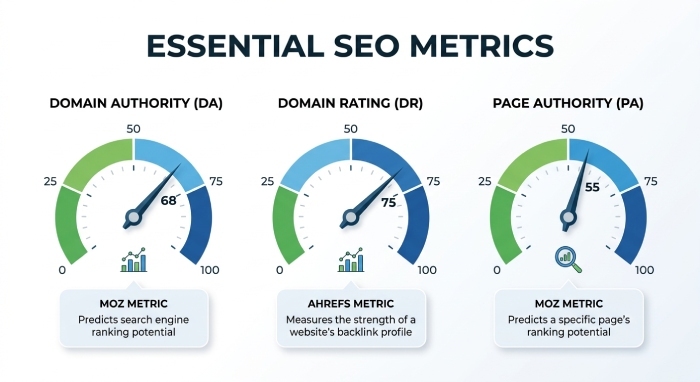
A DA checker can give you a quick read on website authority, but it should not be used in isolation. A site with high domain authority but irrelevant content, inflated backlink data, or poor organic traffic may not be a strong link opportunity.
DA, DR, and Authority Score Are Comparative Metrics
Domain authority, domain rating, and authority score are best used for site comparison and site benchmarking. They help you compare industry competitors, search competitors, acquisition targets, and client prospecting lists. However, they are relative authority indicators, not absolute proof that a link will improve keyword rankings.
API Checks for Repeatable Workflows
If you evaluate domains at scale, APIs can make your workflow more consistent. For example, teams using custom dashboards or internal link research systems can Try the free DR API to retrieve domain rating data programmatically.
Way 2: Compare Domain Authority With Organic Traffic and Keyword Rankings
A strong domain authority score becomes much more meaningful when it aligns with organic traffic and keyword rankings. If a website has a solid DR score, healthy referring domains, and visible top-ranking keywords, it is more likely to have real site visibility in search engine result pages.
Use tools such as Semrush, Ahrefs Site Explorer, Moz Pro, or Google Search Console access when available to compare website authority with organic traffic. A domain authority checker may show strong site authority, but if the site has declining traffic, no ranking strength, and few estimated clicks, you should investigate further.
For a quick cross-check, the Semrush website authority checker can help you review authority score, SEO metrics, and competitive indicators alongside broader SEO strategy considerations.
Traffic-to-Authority Validation
When benchmarking competitors, compare domain authority with:
- Organic traffic growth or decline
- Keyword rankings across commercial and informational terms
- Top-ranking keywords
- Featured snippets and Top Featured Snippets visibility
- SERP coverage across the Search Engine Results Page (SERP)
- Estimated clicks from ranking pages
A site with moderate domain authority but strong organic traffic, relevant keyword rankings, and valuable featured snippets may be a better outreach target than a higher-DA site with weak search visibility.
Use Competitor Analysis to Set Realistic Thresholds
Competitor analysis helps you avoid arbitrary DA checker cutoffs. In one niche, a domain rating of 35 may be strong; in another, a DR score below 70 may be underpowered. Site benchmarking against industry competitors and search competitors gives context to domain authority, website authority, backlink profile strength, and referring domains.
Way 3: Check the Site’s Backlink Profile for Quality and Relevance
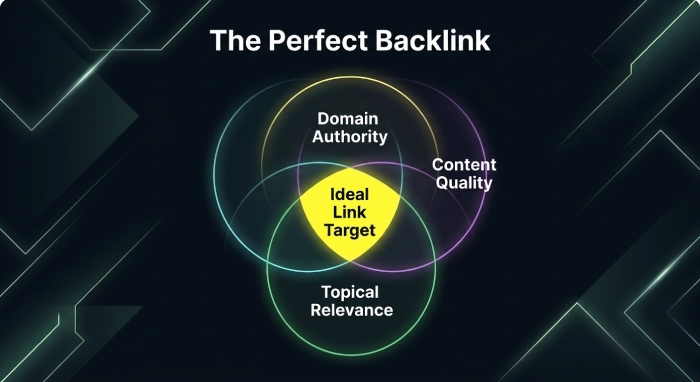
The backlink profile is one of the most important signals to evaluate before building backlinks. A domain can have high domain authority, but if its backlink profile is built on low-quality backlinks, irrelevant referring domains, or manipulative linking root domains, the link opportunity may carry limited value.
Use a domain authority checker alongside backlink data from Moz Link Explorer, Ahrefs Site Explorer, Semrush, or a DA PA Checker. DAPAchecker.org, for instance, is often used for quick DA, PA, and site authority checks, and you can review it via DAPAchecker.org.
Linking Root Domains vs. Referring Domains
Linking root domains and referring domains are often discussed together, but they are not always interpreted the same way across tools. In general, referring domains show how many unique websites link to a domain, while linking root domains emphasize unique root-level sources. A strong backlink profile usually has diverse linking root domains, relevant referring domains, and natural anchor text patterns.
Look beyond raw counts. A site with 500 relevant referring domains from real publishers may be stronger than a site with 5,000 low-quality linking root domains from directories, expired domains, or link farms.
Review Top Linking Domains and Top Pages by Links
Top linking domains reveal who is passing link equity to the site. Top pages by links show which content attracts backlinks. If the site’s best-linked pages are thin, off-topic, or generated only for link exchanges, the backlink profile may not support sustainable SEO performance.
Also review unique backlinks, external backlinks, and the overall Link Data Set. Strong sites usually earn links from relevant publications, industry resources, research pages, and editorial mentions rather than random sitewide footer links.
Way 4: Review Spam Score, Toxic Links, and Link Neighborhoods
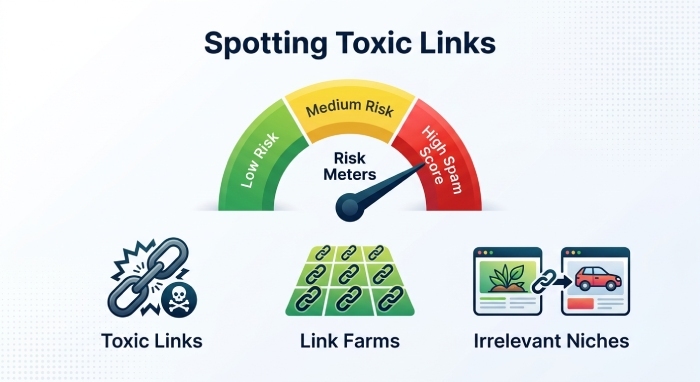
Spam Score and toxic link patterns are essential checks before outreach. A high DA checker result can be misleading if the domain has been inflated through manipulative link building. Moz’s Spam Score, Semrush toxicity markers, and manual backlink profile reviews can help identify risk.
You can also test multiple domain authority checker tools, such as the Seomatic domain authority checker, to compare domain authority, website authority, and SEO metrics across different data sources.
Red Flags in a Backlink Profile
Watch for these warning signs:
- Sudden spikes in referring domains without traffic growth
- Many linking root domains from unrelated countries or languages
- Excessive exact-match anchor text
- Links from deindexed or suspicious sites
- Thin guest post networks
- Sitewide links from irrelevant websites
- Overreliance on directories, profile links, or autogenerated pages
Tools like Google Index Checker, Robots Text Generator, Sitemap Generator, Ip Lookup, and Backlinks Generator may appear in broader SEO tool suites, but they should not replace serious backlink profile analysis. For outreach decisions, prioritize quality backlinks, topical relevance, and real editorial standards.
Link Neighborhoods Matter
A website’s link neighborhood can affect how much confidence you place in its domain authority. If a site links heavily to casinos, payday loans, adult content, or unrelated affiliate pages, its website authority may be less valuable for your SEO strategy. Even if the DR score looks strong, poor outbound link patterns can reduce trust and link equity.
Way 5: Evaluate Topical Relevance and Content Quality Before Outreach
The final step is to evaluate topical relevance and content quality. Domain authority and domain rating are useful filters, but relevance determines whether a backlink makes sense. A link from a lower-DA niche publication can outperform a link from a high-DA but irrelevant general site.
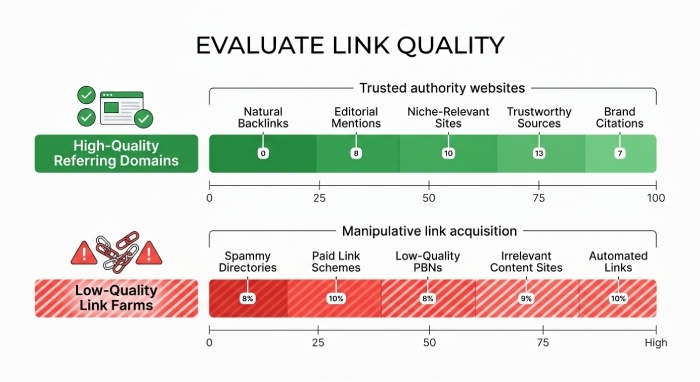
Use a domain authority checker first, then manually inspect content quality, on-site features, author credibility, internal linking, and editorial consistency. Free tools such as the Small SEO Tools domain authority checker can support quick checks, while platforms like Xamsor’s Moz domain authority checker can add another DA checker comparison point.
Content Quality Signals to Review
Before outreach, check whether the site publishes original, useful, and well-structured content. Review whether articles rank in the SERP, earn organic traffic, attract referring domains, and cover topics in depth. Strong sites tend to have visible keyword rankings, credible authors, clean layouts, and helpful internal links.
Will Critchlow and SearchPilot often emphasize testing SEO assumptions rather than relying on surface-level metrics. That mindset applies here: do not treat domain authority, DR score, or page authority as the full answer. Combine SEO metrics with human review.
Match Link Opportunities to Search Intent
The best link opportunities align with your audience, topic, and commercial goals. For example, if your page targets technical SEO professionals, a backlink from a respected SEO testing, analytics, or software publication is more relevant than a generic lifestyle blog with higher domain authority.
Use domain authority, website authority, backlink profile quality, linking root domains, referring domains, domain rating, and DR score as filters—but let topical relevance and editorial quality determine whether the site belongs in your outreach pipeline.