July 24, 2026 · asma
7 Top Content Curation Tools to Streamline Your Content Strategy
Discover the 7 best content curation tools to streamline content discovery, planning, publishing, and collaboration. Compare features, workflows, and AI-powered solutions like StealthWriter to build a smarter content marketing strategy.

Strong content curation helps teams turn content discovery into a repeatable system: finding relevant industry insights, organizing news feeds and RSS feeds, saving evergreen content, and publishing curated content across channels. The best content curation tools support content planning, feed management, content scheduling, social media engagement, and a clear content approval workflow so every post aligns with your content marketing strategy.
For broader comparisons, resources like this overview of content curation tools show how platforms differ across content discovery, publishing tools, approvals, content analytics, and social media management. Below are seven content curation solutions worth considering.
A strong curation stack should also help teams think beyond one-off posts. Modern marketing teams often need curated insights that can be repurposed into newsletter sections, social posts, internal updates, sales enablement snippets, thought leadership commentary, and blog outlines. That is where the idea of Universal Content becomes useful: curated material should be flexible enough to support multiple formats, channels, and audiences without losing quality or brand relevance.
The tools below vary in scope. Some are built for saving and organizing research, while others support enterprise governance, social publishing, analytics, or AI-assisted rewriting. The best choice depends on whether your priority is faster content discovery, better collaboration, stronger approval workflows, or more consistent multi-channel publishing.
Tool #1: StealthWriter — Generate, Optimize, Humanize, and Curate AI-Powered Content
StealthWriter is useful for teams that want AI-powered curation support alongside content optimization and rewriting. It can help transform sourced material into more natural, readable formats while supporting content ideation and topic ideation for blog posts, newsletters, and social media captions.
Best For AI-Assisted Content Curation
StealthWriter fits into a content marketing strategy when your team needs to refine curated content before publishing. Instead of simply reposting industry insights, marketers can use the tool to summarize, humanize, and adapt content formats for LinkedIn, X, Facebook, Threads, Mastodon, Bluesky, or a website built on WordPress, Drupal, Joomla, Shopify, or Weebly.
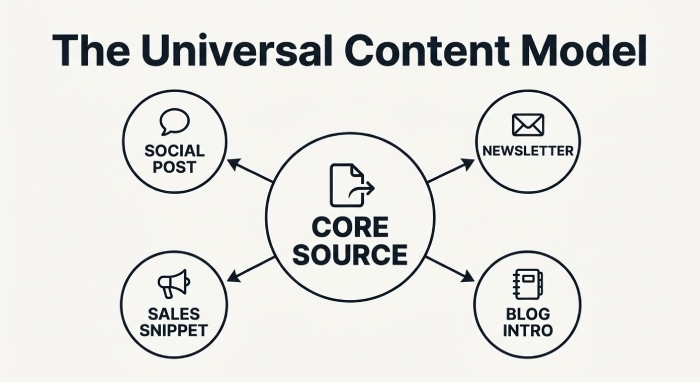
This makes it especially helpful when a team wants to turn a single research source into several pieces of Universal Content. For example, an industry report can become a concise social post, an executive summary, a newsletter blurb, a short script for a video caption, or a commentary-led blog intro. The key is to add original perspective and avoid treating AI rewriting as a replacement for editorial judgment.
Workflow Benefits
It supports content planning by helping teams move from content research to content organization faster. When paired with a centralized dashboard, a media library, and content approval workflows in tools like Planable or Slack, it can strengthen the review and approval process.
StealthWriter can also help standardize tone across curated assets. This is useful for teams with multiple contributors, where content may otherwise sound inconsistent from one post to the next. Editors can create a repeatable process: collect source material, draft a short summary, add brand commentary, humanize the language, and send the final version through approval before scheduling.
Why It Stands Out
StealthWriter is especially relevant for AI-powered curation, where the goal is not just content aggregation but creating useful, brand-safe curated content that supports brand authority.
Tool #2: Pocket — Save, Organize, and Revisit High-Value Content
Pocket is one of the simplest content curation tools for batch saving articles, videos, research links, and visual content from across the web. It is ideal for individual creators, strategists, and small teams that need lightweight content collections without a complex content approval workflow.
Best For Personal Content Discovery
Pocket helps with content discovery by letting users save evergreen content, Market Intelligence reports, blog posts, Reddit discussions, YouTube videos, and industry insights for later review. Curators can tag resources by campaign, audience, funnel stage, or content formats.
Because Pocket is simple, it works well as a personal research habit. A strategist can save articles during the week, review them in a focused session, and then choose which pieces deserve to become curated content. This reduces the pressure to make publishing decisions in real time and helps teams separate content discovery from content production.
Feed Management Use Case
Although Pocket is not a full feed management platform like Feedly or Flipboard, it supports content organization by keeping high-value references in one place. For content planning, this makes it easier to revisit relevant ideas before building a content calendar or social media content calendar.
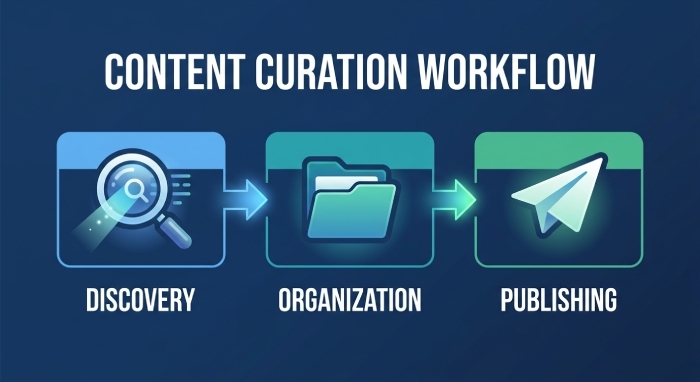
If your team already uses a publishing platform, Pocket can act as the intake layer. Saved resources can be reviewed weekly, tagged by theme, and transferred into a more structured planning tool only after they pass a relevance check.
Practical Tip
Use Pocket as an early-stage content research library, then move approved curated content into your publishing and content scheduling workflow.
Tool #3: Curata — Discover, Curate, and Share Content at Scale
Curata is one of the more advanced content curation solutions for enterprise teams. It focuses on content discovery, content aggregation, content sharing, and content distribution, making it valuable for organizations that publish across email, web, and social channels.
Best For Enterprise Content Curation
Curata supports scalable content curation by helping teams identify relevant sources, filter content, and distribute curated content. In more mature content marketing strategy operations, Curata can complement platforms such as Adobe, Feedly, Quuu, Flockler, Scoop.it, and Planable.
For enterprise teams, the value is often less about finding one interesting article and more about creating a reliable, governed curation engine. Teams may need to serve different regions, product lines, stakeholder groups, or vertical markets while maintaining a consistent editorial standard. A structured platform can help prevent duplicated effort and make curated content easier to reuse.
Approval and Governance
For larger teams, approvals matter. Curata can fit into a content approval workflow where editors review sourced material, verify accuracy, check for content moderation issues, and approve final assets before publishing.
Governance is especially important when curating third-party content. Teams should confirm that summaries are accurate, attribution is clear, claims are not exaggerated, and the curated source aligns with brand values. This process protects brand authority and helps keep content distribution consistent across channels.
Why Teams Choose It
Curata is useful when content collaboration, feed management, and multi-platform sharing need to be standardized across departments. For additional market context, this guide to best content curation software compares several content curation solutions for different business needs.
Tool #4: BuzzSumo — Find Trending Topics and High-Performing Content
BuzzSumo is a leading platform for content discovery, trending topics, influencer discovery, and competitive content research. It helps marketers understand which articles, videos, and social posts are gaining traction across platforms.
Best For Data-Driven Content Ideation
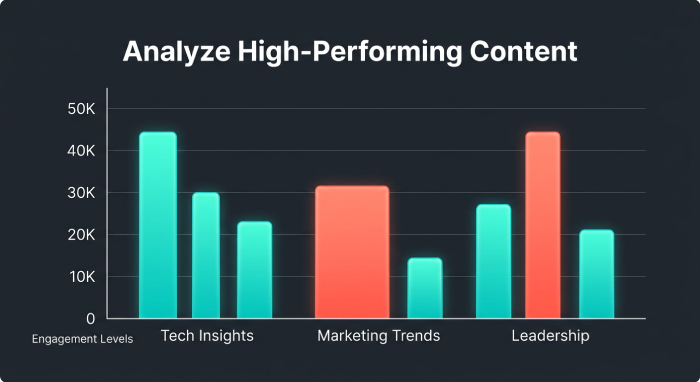
BuzzSumo strengthens content planning by showing what audiences already engage with. Teams can analyze high-performing curated content, monitor social sharing, track social media engagement, and identify opportunities for original commentary.
The platform is especially useful when marketers want to validate content ideas before investing in production. If several articles on a topic are performing well, a team can decide whether to curate the best sources, publish a reaction, create a comparison, or develop a deeper original asset that fills a content gap.
Market Intelligence and Influencer Discovery
BuzzSumo’s Market Intelligence features and Influencer Discovery Tool are useful for finding journalists, creators, and industry experts. This is valuable for UGC curation, user generated content campaigns, and influencer-led content marketing strategy initiatives.
Influencer discovery can also support relationship-building. Instead of only sharing a creator’s post, brands can add thoughtful commentary, tag the source appropriately, and build a pattern of useful engagement. Over time, this can support partnerships, expert roundups, and co-created content opportunities.
Publishing Workflow Fit
BuzzSumo is not primarily a publishing tool, so teams often pair it with content scheduling and social media management platforms. Once content is selected, it can move into a content approval workflow for approvals, editing, and final publishing. You can also review curated tool roundups such as this list of content curation tools to compare discovery-focused platforms.
Tool #5: Scoop.it — Build Topic Hubs and Share Curated Insights
Scoop.it helps marketers create topic-based hubs around specific themes, industries, or audience interests. It is especially effective for building brand authority through consistent content curation and expert commentary.
Best For Topic Hubs and Content Sharing
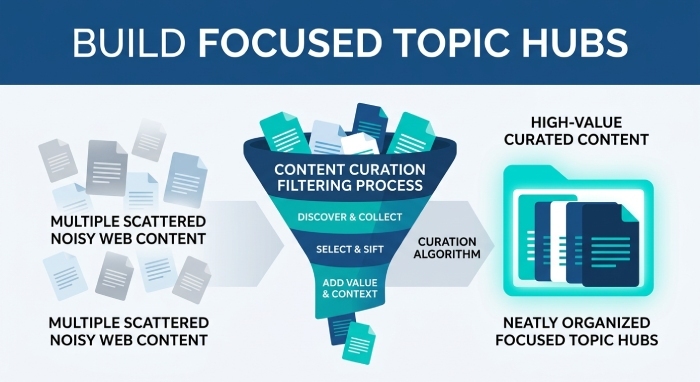
Scoop.it enables teams to collect, annotate, and share curated content across web properties and social channels. It is helpful for companies that want to build content collections around niche subjects, product categories, or thought leadership themes.
Topic hubs work best when they are focused. Instead of curating every article in a broad industry, teams can build hubs around specific pain points, trends, or buyer questions. This makes the curated experience more useful for the audience and easier to connect to a broader content marketing strategy.
Custom Feeds and Feed Customization
With custom feeds and feed customization, Scoop.it improves feed management for teams that monitor many sources. This makes content discovery more focused and helps reduce noise from irrelevant news feeds.
Feed customization also helps teams maintain consistency. When sources are aligned with editorial themes, curators spend less time filtering irrelevant updates and more time adding meaningful commentary.
Where It Fits
Scoop.it can support content planning, content distribution, and social media engagement by turning curated insights into repeatable publishing assets. For brand teams evaluating similar platforms, Bazaarvoice’s roundup of content curation tools for your brand offers useful perspective on how curation supports customer trust.
Tool #6: UpContent — Curate Relevant Content for Email, Social, and Web
UpContent is built for teams that need relevant, compliant, and easy-to-share curated content. It works well for newsletters, employee advocacy, partner communications, and social media engagement campaigns.
Best For Relevant Content Recommendations
UpContent helps streamline content discovery by surfacing articles based on topics, keywords, and trusted sources. It supports feed management, content aggregation, and content planning while keeping curated content aligned with business goals.
This relevance-first approach is helpful for teams that curate content for specific audience segments. A financial services audience, for example, may need different curated sources than a SaaS founder audience or a healthcare operations audience. UpContent can help keep recommendations focused enough to support practical publishing decisions.
Collaboration and Approval Workflows
For regulated or brand-sensitive industries, content approval workflows are essential. UpContent can support team collaboration by helping marketers review curated content before it enters a content approval workflow, social media content calendar, or manual scheduling queue.
Teams can also use UpContent as part of an employee advocacy process. Marketing can curate approved links, add suggested captions, and make it easier for internal advocates to share content without creating compliance risks.
Practical Distribution Channels
Teams can use UpContent for email newsletters, LinkedIn posts, Facebook updates, X threads, Google Business Profile updates, and internal Slack sharing. For a historical look at serious marketer tools, Forbes also published a list of content curation tools for serious marketers that reflects how central curation has become to modern content marketing strategy.
Tool #7: ContentStudio — Plan, Curate, Schedule, and Analyze Content
ContentStudio combines content curation, social media management, content scheduling, and analytics in one centralized dashboard. It is a strong choice for agencies and marketing teams that want to manage content discovery, curated content, approvals, and publishing from a single workspace.
Best For End-to-End Content Planning
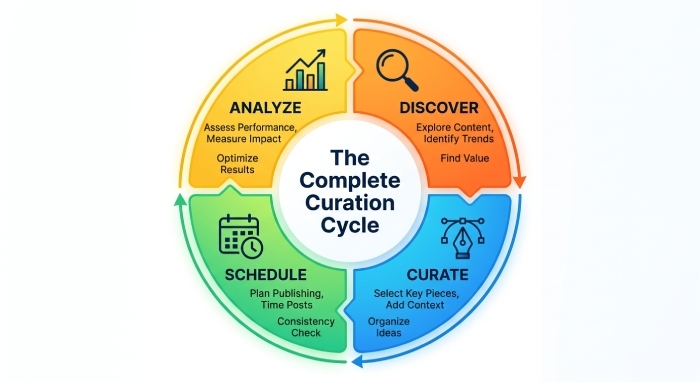
ContentStudio supports the full content marketing strategy cycle: content research, content ideation, content calendar planning, content approval workflow, content scheduling, publishing, and reporting. Teams can discover trending topics, organize content collections, and prepare multi-platform sharing campaigns.
For agencies, the centralized workflow can reduce context switching. Instead of using one tool for discovery, another for scheduling, another for analytics, and a separate spreadsheet for approvals, teams can manage more of the process in one place.
Social Monitoring and Engagement
Its social monitoring capabilities help teams track conversations across channels like LinkedIn, X, Facebook, Reddit, YouTube, Mastodon, Threads, and Bluesky. That visibility can improve social media engagement by helping brands respond to what audiences actually discuss.
Social monitoring also improves the quality of curated commentary. When teams understand what customers, creators, and competitors are saying, they can add context instead of simply reposting links.
Content Analytics and Optimization
Content analytics help marketers see which curated content drives clicks, shares, and engagement. This makes it easier to refine content curation solutions over time and improve future feed management.
Analytics are especially valuable when comparing formats. A curated article may perform well as a newsletter link but poorly as a social post, while a short insight from the same source may work better as a carousel, thread, or executive summary. Reviewing results helps teams turn curation into a learning system.
How To Choose Among These Content Curation Solutions
The right platform depends on your workflow. Pocket is ideal for simple saving and content organization. BuzzSumo is best for trending topics, influencer discovery, and content research. Curata, Scoop.it, UpContent, and ContentStudio are stronger for structured feed management, content distribution, and team collaboration. StealthWriter is useful when AI-powered curation and content refinement are priorities.
For peer perspectives, Reddit discussions about finding a good content curation tool can reveal practical user concerns, while G2’s guide to best content curation software provides another comparison point. If your team also needs collaborative planning and content approval workflows, Planable is free for up to 50 posts, making it easy to test content planning, approvals, and publishing alongside your preferred content curation tools.
Build a Universal Content Curation Workflow
Choosing a tool is only one part of improving content curation. Teams also need a repeatable workflow that explains how ideas move from discovery to approval to publishing. A simple process might include source monitoring, content saving, relevance scoring, editorial annotation, compliance review, scheduling, and performance analysis.
This is where Universal Content can become a practical operating principle. Instead of curating content for a single post, teams can ask how each useful source might support multiple channels. A research report could inspire a newsletter section, a sales enablement note, a LinkedIn post, an internal executive update, and a short blog commentary. A customer discussion from Reddit might become a social listening insight, a FAQ update, or a topic for original content ideation.
Map Sources to Audience Intent
The strongest curated content starts with audience intent. Before saving another article or adding another feed, teams should define which audience questions they want to answer. For example, top-of-funnel audiences may want trend explainers and accessible summaries, while bottom-of-funnel audiences may prefer benchmarks, buyer guides, case studies, or expert commentary.
Mapping sources to intent also prevents content overload. If every saved article looks interesting but does not serve a specific audience need, the content library becomes difficult to use. A clear tagging system can help: tags might include awareness, consideration, decision, industry news, competitor insight, customer pain point, product education, or thought leadership.
Balance Automation With Editorial Judgment
Automation can make content discovery and feed management faster, but editorial judgment is what makes curation valuable. Tools can surface trending topics, recommend links, and organize feeds, but marketers still need to decide whether a source is credible, whether the topic fits the brand, and whether the audience will benefit from the curated asset.
A healthy workflow combines both. Automation handles repetitive discovery and organization tasks, while editors add context, verify claims, write commentary, and adapt the content for each channel. This balance helps teams avoid shallow content aggregation and build stronger brand authority through thoughtful curation.
Measure Performance Across Channels
Curated content should be measured just like original content. Useful metrics include clicks, saves, shares, comments, newsletter engagement, referral traffic, assisted conversions, and audience growth. For social media engagement, qualitative signals also matter: Are people asking follow-up questions? Are industry experts responding? Are internal teams using the curated insights?
Performance data helps teams refine their curation strategy over time. If curated trend posts consistently outperform generic news updates, the team can shift more effort toward analysis and commentary. If newsletter readers click research summaries more than opinion pieces, that insight can shape future content planning.
Evaluation Criteria for Content Curation Tools
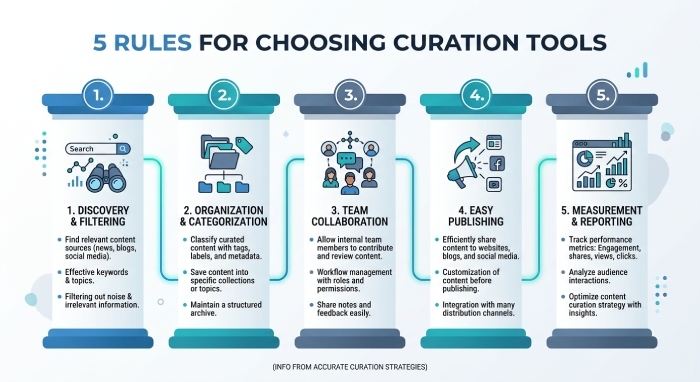
When comparing content curation tools, look beyond the feature list and consider how each platform fits into your team’s existing content operations. A powerful enterprise tool may be unnecessary for a solo creator, while a lightweight saving app may not provide enough governance for a regulated brand.
Start with discovery quality. The platform should help surface relevant content from trusted sources without overwhelming your team with noise. Next, consider organization features such as tagging, folders, custom feeds, source filters, and content collections. These features make it easier to turn content research into a usable library.
Collaboration is another major factor. If multiple people contribute to content planning, the tool should support comments, assignments, approvals, and visibility into status. For agencies or larger marketing departments, role-based access and approval history can reduce confusion and protect quality.
Publishing fit also matters. Some tools are excellent for discovery but need to be paired with separate content scheduling platforms. Others include scheduling, social media management, and analytics in one workspace. The right choice depends on whether you want a specialized tool or a more integrated system.
Finally, review reporting and optimization features. Content analytics should help you understand which curated content supports engagement, traffic, authority, and conversions. Without reporting, it is difficult to know whether your curation program is improving or simply adding more posts to the calendar.
Final Takeaway: Make Curation Repeatable
The best content curation tools do more than help teams find links. They create a repeatable system for discovering relevant insights, organizing useful sources, adding original context, getting approvals, and publishing across the right channels. Whether your team chooses Pocket, StealthWriter, Curata, BuzzSumo, Scoop.it, UpContent, ContentStudio, or a combination of tools, the goal should be the same: make curated content useful, trustworthy, and aligned with your content marketing strategy.
A strong curation process also improves efficiency. Teams can spend less time searching for ideas and more time shaping them into meaningful assets. With the right workflow, curated content can support newsletters, social media engagement, blog planning, employee advocacy, sales conversations, and brand authority.
In short, content curation works best when it is strategic rather than reactive. Build a focused source list, define clear approval steps, use analytics to refine performance, and treat every strong source as potential Universal Content that can serve multiple audiences and channels.