August 6, 2026 · asma
7 Ways to Use a Keyword Difficulty Checker to Find Easier Ranking Opportunities
Learn how to use a keyword difficulty checker to identify low-competition keywords, evaluate SERP competition, prioritize ranking opportunities, and build a smarter SEO strategy that drives sustainable organic traffic.

Why Keyword Difficulty Matters Before You Target a Search Query
A keyword difficulty checker helps you estimate how hard to rank for a specific search query in organic search. Instead of choosing keywords based only on search volume, you can compare keyword difficulty, competition, search intent, content relevance, backlinks, and the strength of the top 10 search results before investing in content.
Most SEO tools assign a keyword difficulty score on a numerical scale, often based on backlink profiles, referring domains, domain qualities, and other ranking factors. Tools such as Ahrefs, SE Ranking, Moz, Semrush, and platforms like SEOWorx can support smarter keyword research by helping teams find easy-to-rank keywords with realistic ranking potential.
What a Keyword Difficulty Score Really Tells You
A keyword difficulty score is an SEO metric, not a guarantee. It gives you a directional view of how hard to rank, especially when paired with SERP analysis, link analysis, and domain analysis. For example, an Ahrefs keyword difficulty estimate often focuses heavily on backlinks and referring domains, while other SEO tools may weigh on-page factors, content relevancy, search traffic, and SERP competition differently.
Don’t Treat the Metric in Isolation
A low keyword difficulty score can still be misleading if the search results are dominated by high-authority brands, government sites, or pages with perfect content relevance. Likewise, a higher keyword difficulty metric may still be worth pursuing if the top-ranking pages are outdated, thin, or poorly aligned with the search query.
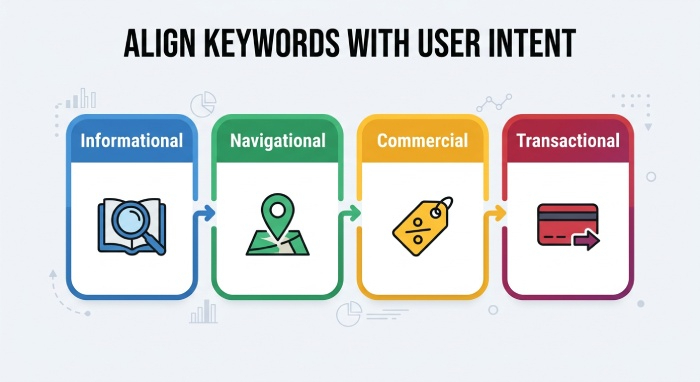
Way #1: Filter for Low-Difficulty Keywords With Clear Search Intent
Start by entering a seed keyword into a keyword difficulty checker, then filter your keyword list by low keyword difficulty and clear intent. The goal is to find organic search opportunities where the search query signals exactly what the user wants.
For example, “best CRM for freelance consultants” is usually easier to interpret than a broad competitive keyword like “CRM.” The keyword difficulty may be lower, the competition may be narrower, and the content relevance requirements may be clearer.
Match Intent Before You Chase Ranking
Look at the top 10 search results and classify the intent: informational, commercial, transactional, or navigational. If Google shows buying guides, comparison pages, or product pages, your content must match that format. A SE Ranking keyword difficulty checker can help you combine keyword difficulty, search volume, SERP overview data, and keyword suggestions before making a keyword selection.
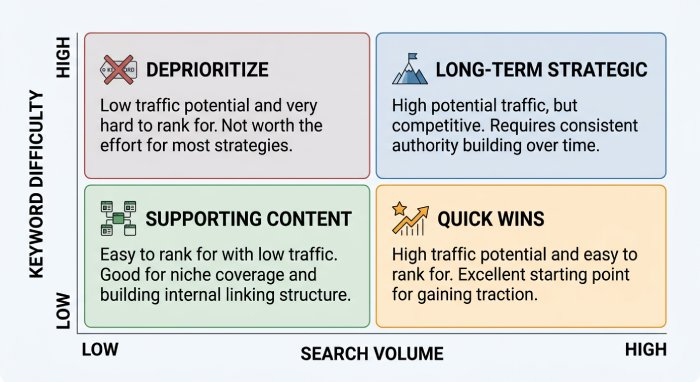
Way #2: Compare Keyword Difficulty Against Search Volume to Find Quick Wins
A keyword with huge search volume is tempting, but it may require years of SEO effort, backlinks, and authority building. Instead, compare search volume against keyword difficulty to identify quick wins: terms with moderate demand, lower competition, and realistic ranking potential.
Build a Simple Opportunity Matrix
Use a spreadsheet or SEO Dashboard to sort keywords into four groups:
- Low keyword difficulty, high search volume: prioritize immediately
- Low keyword difficulty, low search volume: use for supporting content
- High keyword difficulty, high search volume: treat as long-term strategic targets
- High keyword difficulty, low search volume: usually deprioritize
This approach helps balance organic traffic potential with how hard to rank. You can also compare organic search data with paid search signals. If advertisers are bidding aggressively in paid search, a lower-difficulty organic search keyword may have strong conversion value.
Use Paid Search Data as a Validation Layer
Tools like Google Keyword Planner can reveal paid search competition and cost-per-click trends. When a keyword has manageable keyword difficulty, steady search volume, and meaningful paid search activity, it often deserves closer SEO analysis.
Way #3: Identify Long-Tail Keywords Competitors Are Overlooking
Long-tail keywords often contain three or more words and reflect a specific search query. They may have lower search traffic individually, but they can collectively drive qualified organic traffic because competition is usually weaker.
A keyword difficulty checker is especially useful here because it can uncover easy-to-rank keywords buried inside a large keyword database. Instead of targeting “project management software,” you might find “project management software for architecture firms” or “how to track client approvals in project management.”
Use Keyword Suggestions to Expand the List
SEO tools such as Keywords Explorer, Keyword Grouper, Keyword Research API, and even an AI Writer can help generate keyword suggestions. Then, use a keyword difficulty checker to validate which ideas have the best mix of difficulty, intent, and ranking opportunity. Free utilities such as the SEO Review Tools keyword difficulty checker can also be useful for quick checks during early keyword research.
Way #4: Analyze SERP Competition Before Choosing a Target Keyword
Keyword difficulty is only the starting point. Before you commit to a target keyword, inspect the SERP manually. The top 10 search results reveal the real competition: who ranks, what type of content ranks, how strong their backlink profiles are, and whether the search engine favors guides, tools, category pages, videos, or local listings.
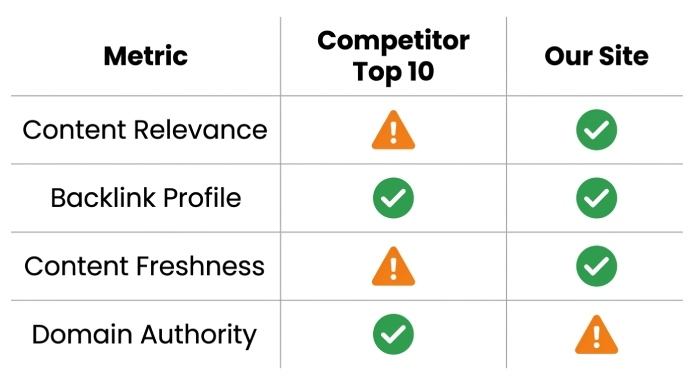
Evaluate the Top-Ranking Pages
Look at each top-ranking page and ask:
- Does the page fully answer the search query?
- How many backlinks and referring domains does it have?
- Is the content fresh, detailed, and expert-led?
- Are on-page factors such as headings, internal links, and schema well optimized?
- Do the domain qualities suggest strong authority or topical expertise?
A tool like Semrush Keyword Overview can support SERP analysis by showing keyword difficulty, SERP features, search volume, paid search indicators, and competitive keywords in one workflow.
When the Top 10 Looks Weak, Move Fast
If the top 10 includes forums, thin blog posts, outdated articles, or pages with poor content relevance, the ranking opportunity may be easier than the keyword difficulty score suggests. That is where expert SEO judgment matters.
Way #5: Find Content Gaps Where Easier Keywords Lack Strong Answers
Content gaps appear when users search for something specific, but the search results do not provide a complete, trustworthy answer. A keyword difficulty checker can surface low-competition terms, but your content gap analysis determines whether you can produce something meaningfully better.
Combine Content Explorer and Site Explorer Workflows
Use Content Explorer to find pages receiving organic traffic from low-difficulty keywords. Then use Site Explorer or a Backlink Checker to review backlink profiles and link acquisition patterns. If weak pages are ranking with few backlinks, you may be able to outperform them through better content, stronger internal linking, and sharper content relevancy.
Platforms like the Backlinko keyword difficulty checker can help validate whether a keyword is worth deeper competitor analysis before you add it to your keyword list.
Way #6: Build Keyword Clusters Around Low-Difficulty Ranking Opportunities
Instead of creating one isolated article per keyword, group related low-difficulty terms into keyword clusters. This helps you build topical authority, improve internal linking, and support stronger search engine ranking over time.
For example, a cluster around “keyword difficulty checker” might include “how keyword difficulty is calculated,” “keyword difficulty vs search volume,” “low keyword difficulty keywords,” and “best SEO tools for keyword research.” Each page supports the broader topic while targeting a distinct search query.
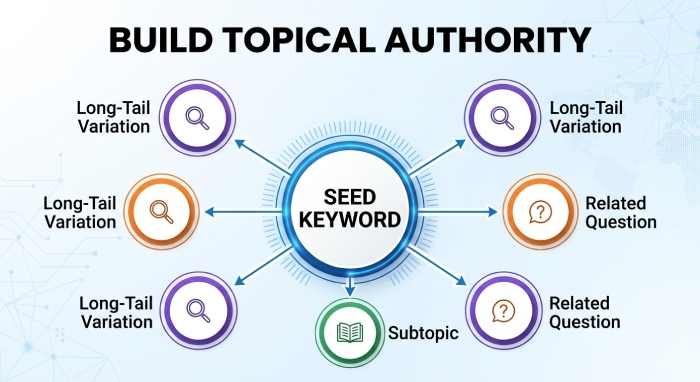
Use Tools to Organize Clusters and Track Performance
A Keyword Grouper can organize related terms, while Rank Tracker, SERP Tracker, and position tracking tools monitor ranking movement across the cluster. A Website Audit can identify technical issues, and a Competitor Analysis Tool can reveal whether rival domains are building similar clusters.
For authority benchmarking, Moz Keyword Difficulty can be useful alongside domain analysis, link analysis, and SERP overview checks.
Way #7: Prioritize Keywords Based on Difficulty, Authority, and Conversion Potential
The best keyword selection process weighs keyword difficulty against your site’s current authority and business value. A new website should usually avoid highly competitive keywords where the top 10 search results are dominated by established brands with thousands of backlinks. A stronger domain may be able to pursue tougher opportunities earlier.
Score Each Keyword Before Publishing
Create a prioritization score that includes:
- Keyword difficulty
- Search volume
- Search intent clarity
- Paid search competition
- Conversion potential
- Content relevance
- Current authority and backlink profiles
- SERP competition
- Fit with existing topical clusters
This keeps SEO decisions grounded in both ranking feasibility and revenue potential. For larger teams, workflows can connect SEO Toolbar research, Backlinks API data, Domain Analysis API insights, Keyword Research API exports, and Content Editor briefs into a single data base.
Account for AI SEO and Emerging SERP Features
Modern search results are changing quickly. AI SEO tools such as AI Search Toolkit, AI Overviews Tracker, Gemini Tracker, ChatGPT Tracker, Perplexity Tracker, and Claude-focused monitoring can help you understand whether AI-generated answers are reducing clicks or creating new opportunities. Visibility platforms such as SE Visible Analyze AI visibility strategically can add another layer beyond traditional organic search ranking.
Teams managing multi-channel content may also use Planable Manage your socials as a team to coordinate promotion after publishing, while White Label dashboards and Lead Generator features can package keyword difficulty, organic traffic, paid search, and competitor analysis insights for clients.